



Checkpoint Kinase (Chk)
DNA damage checkpoint and the spindle checkpoint are two cell cycle surveillance systems, which guard against genomic instability. The DNA damage checkpoint kinases CHK1 and CHK2 are central to the induction of cell cycle arrest, DNA repair, and apoptosis as elements in the DNA-damage checkpoint. The components of the spindle checkpoint include Mad1, Mad2, Mad3(BubR1), Bub3 and the kinases Bub1, Mph1(Mps1) and Aurora B.
Cells that suffer DNA damage activate the checkpoint kinases CHK1 and CHK2, which signal to initiate repair processes, limit cell-cycle progression and prevent cell replication, until the damaged DNA is repaired.
The spindle checkpoint causes metaphase arrest when kinetochore-microtubules are unattached during mitosis. The SAC consists of ‘sensor’ proteins, such as Mad1, Bub1 and Mps1; a ‘signal transducer’, consisting of the mitotic checkpoint complex, composed of Mad2, Bub3, BubR1 and Cdc20; and an ‘effector’ known as the anaphase promoting complex/cyclosome (APC/C).
Checkpoint Kinase (Chk) Isoform Specific Products
All Product Categories
-
Checkpoint Kinase (Chk) Inhibitors
(92)
View all products
-
Checkpoint Kinase (Chk) Agonist
(1)
View all products
-
Checkpoint Kinase (Chk) Activators
(15)
View all products
-
Checkpoint Kinase (Chk) Degraders
(4)
View all products
-
Checkpoint Kinase (Chk) Substrates
(2)
View all products
-
Checkpoint Kinase (Chk) Ligands
(2)
View all products
-
Checkpoint Kinase 1 (Chk1) Proteins
(2)
View all products
-
Checkpoint Kinase 2 (Chk2) Proteins
(4)
View all products
-
Checkpoint Kinase (Chk) Related Products (122)
Related Products (122)

-
Recombinant Proteins (6)
-
Antibodies (10)
-
Checkpoint Kinase (Chk) Isoform Comparison
-
Chek1 Rat Pre-designed siRNA Set A
 0 ImagesCat. No.: HY-RS02618
Chek1 Rat Pre-designed siRNA Set A contains three designed siRNAs for Chek1 gene (Rat), as well as a negative control, a positive control, and a FAM-labeled negative control.
-
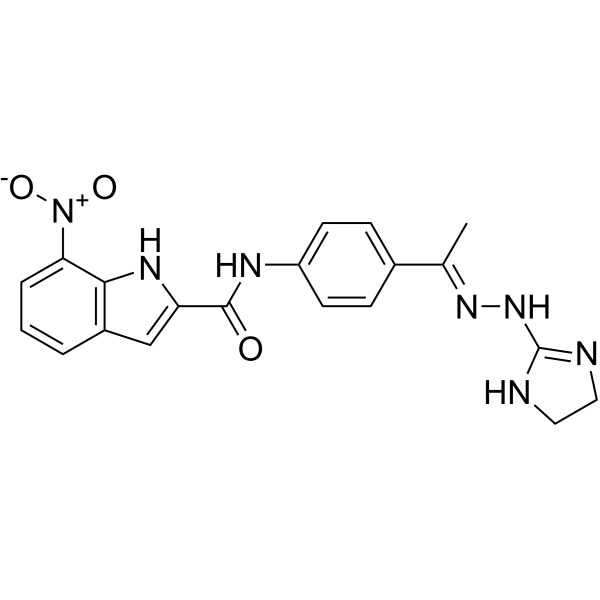
Isogranulatimide
 0 ImagesCat. No.: HY-112347CAS No.: 244148-46-7Isogranulatimide is a selective checkpoint kinase 1 (Chk1) inhibitor with an IC50 value of 0.1 μM. Isogranulatimide inhibits the G2/M checkpoint and inhibits the growth of p53-mutant tumor cells. Isogranulatimide is promising for research of tumors associated with DNA damage response.
-
Cyproheptadine-d3
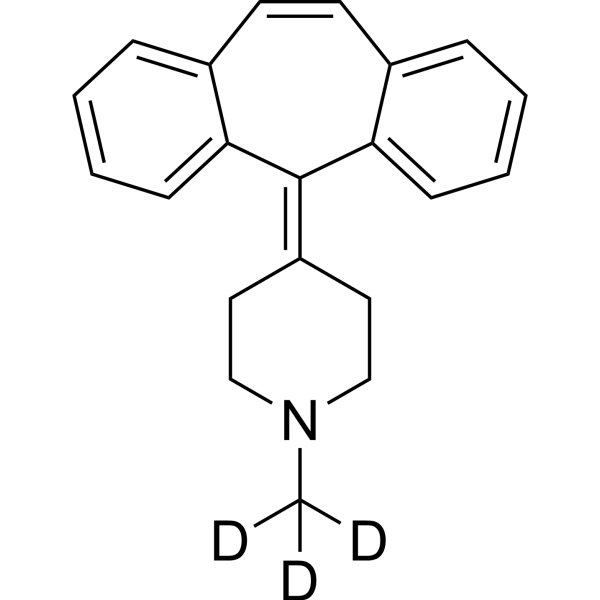 0 ImagesCat. No.: HY-B1622SCAS No.: 2712455-05-3Cyproheptadine-d3 is the d3-labeled Cyproheptadine (HY-B1622). Cyproheptadine acts as a p38 MAP kinase activator, CHK2 activator, histamine H1 receptor inhibitor and serotonin receptor inhibitor. Cyproheptadine mediates cell cycle arrest via G1 phase arrest, G1/S transition arrest, G0/G1 phase arrest, reduced expression of cyclins D1/D2/D3, upregulated expression of HBP1, p16, p21, p27, and decreased phosphorylation of retinoblastoma protein. Cyproheptadine induces Apoptosis by increasing PARP and cleaved PARP, as well as activating the mitochondrial caspase pathway. Cyproheptadine inhibits tumor growth with extremely low toxicity to normal cells. Cyproheptadine can be used in research related to hepatocellular carcinoma, multiple myeloma and acute myeloid leukemia.
-
PD-321852
 0 ImagesCat. No.: HY-124731CAS No.: 622856-21-7PD-321852 is a Chk1 inhibitor, with IC50 of 5 nM. PD-321852 can be used in anti-cancer research.
-
Chk2-IN-2
 0 ImagesCat. No.: HY-158303CAS No.: 2984543-29-3Chk2-IN-2 (compound 2) is a selective inhibitor of CHK2 with potential anticancer activity.
-
MCL1020
 0 ImagesCat. No.: HY-159707CAS No.: 2309309-69-9

-
CHEK2 Human Pre-designed siRNA Set A
 0 ImagesCat. No.: HY-RS02619
CHEK2 Human Pre-designed siRNA Set A contains three designed siRNAs for CHEK2 gene (Human), as well as a negative control, a positive control, and a FAM-labeled negative control.
-
Ziptide
 0 ImagesCat. No.: HY-P10367CAS No.: 518069-98-2Ziptide is a substrate for MAPK activated protein kinase 2 (MAPKAPK2, Km = 5 μM), MAPKAPK3 (Km = 30 μM), PARK (Km = 40 μM), checkpoint kinase 1 (Chk1, Km = 5 μM), AMP-activated protein kinase (AMPK, Km = 75 μM), and calcium/calmodulin-dependent protein kinase II (CamKII, Km = 300 μM).
-
Chek2 Mouse Pre-designed siRNA Set A
 0 ImagesCat. No.: HY-RS02620
Chek2 Mouse Pre-designed siRNA Set A contains three designed siRNAs for Chek2 gene (Mouse), as well as a negative control, a positive control, and a FAM-labeled negative control.
-
Chek2 Rat Pre-designed siRNA Set A
 0 ImagesCat. No.: HY-RS02621
Chek2 Rat Pre-designed siRNA Set A contains three designed siRNAs for Chek2 gene (Rat), as well as a negative control, a positive control, and a FAM-labeled negative control.
-
BEN-28010
 0 ImagesCat. No.: HY-186085CAS No.: 3033961-38-2BEN-28010 is a selective, orally active, blood-brain barrier permeable CHK1 inhibitor with an IC50 of 4.0 nM. BEN-28010 functions as a radiosensitizer, exhibits antitumor efficacy in GBM models. BEN-28010 can be used for the research of glioblastoma.
-
Cyproheptadine hydrochloride (Standard)
 0 ImagesSynonyms: Cyproheptadine HCl (Standard)Cyproheptadine hydrochloride (Standard) (Cyproheptadine HCl (Standard)) is the analytical standard of Cyproheptadine hydrochloride (HY-B0366A). This product is intended for research and analytical applications. Cyproheptadine hydrochloride (Cyproheptadine HCl) acts as a p38 MAP kinase activator, CHK2 activator, histamine H1 receptor inhibitor and serotonin receptor inhibitor. Cyproheptadine hydrochloride mediates cell cycle arrest via G1 phase arrest, G1/S transition arrest, G0/G1 phase arrest, reduced expression of cyclins D1/D2/D3, upregulated expression of HBP1, p16, p21, p27, and decreased phosphorylation of retinoblastoma protein. Cyproheptadine hydrochloride induces Apoptosis by increasing PARP and cleaved PARP, as well as activating the mitochondrial caspase pathway. Cyproheptadine hydrochloride inhibits tumor growth with extremely low toxicity to normal cells. Cyproheptadine hydrochloride can be used in research related to hepatocellular carcinoma, multiple myeloma and acute myeloid leukemia.
-
BPTQ
 0 ImagesCat. No.: HY-124122CAS No.: 1802665-43-5BPTQ is a potent inhibitor against VEGFR1 and CHK2 with IC50 values of 0.54 and 1.70 µmol/L, respectively. BPTQ is also an intercalator of DNA with anticancer activities. BPTQ inhibits the proliferation of HL-60 cells by arresting cells at S and G2/M phase with an IC50 value of 12 µmol/L. BPTQ also activates the mitochondria-mediated Apoptosis pathway by a decrease in mitochondrial membrane potential, increase in the Bax:Bcl-2 ratio and activation of caspases.
-
Graviquinone
 0 ImagesCat. No.: HY-180357CAS No.: 1383995-51-4Graviquinone is a Chk1 inhibitor. Graviquinone exhibits potent cytotoxicity against various cancer cell lines. Graviquinone possesses the characteristics of bypassing ABCB1-mediated multidrug resistance, selectively damaging cancer cell DNA, and regulating the DNA damage response. Graviquinone can also enhance cytotoxicity by increasing ROS levels in cancer cells. Graviquinone can be used for cancer research.
-
CBP-501 acetate
 0 ImagesCat. No.: HY-16129APurity: 99.75%CBP-501 acetate, a cell-permeable calmodulin-binding peptide and a G2-abrogating drug candidate, inhibits the activity of multiple Ser216-specific kinases, such as MAPKAP-K2, C-Tak1, CHK1 and CHK2, with IC50 values of 0.9 μM, 1.4 μM 3.4 μM and 6.5 μM, respectively. CBP-501 acetate is used for various types of cancer.
-
DHI1
 0 ImagesCat. No.: HY-175261DHI1 is an anti-leukemia agent with high selectivity for Jurkat (IC50 = 21.83 μM) and HL-60 (IC50 = 19.14 μM) leukemia cells and has low toxicity to non-cancerous cells. DHI1 can induce G2/M phase cell arrest in Jurkat and HL-60 leukemia cells, as well as S phase arrest in HL-60 cells, and has significant effects on cell cycle signaling molecules Wee1, cyclin B1, cdc2 on Tyr15, and Chk1. DHI1 inhibits the migration and invasion of Jurkat and HL-60 cells by disrupting cytoskeletal actin filaments. DHI1 can be used to study hematological malignancies.
-
BBI-355
 0 ImagesCat. No.: HY-171759CAS No.: 3017958-71-0BBI-355 (Compound 1) is an orally active, checkpoint kinase 1 (CHK1) inhibitor. BBI-355 is useful for the study of cancers with oncogene amplification.
-
4"-Isovalerylspiramycin I
 0 ImagesCat. No.: HY-N15249CAS No.: 267662-22-6Synonyms: Isovalerylspiramycin I; Shengjimycin E4"-Isovalerylspiramycin I (Isovalerylspiramycin I) is a topoisomerase 1 (TOP1) inhibitor and an antitumor agent. 4"-Isovalerylspiramycin I directly binds to TOP1, suppresses DNA replication, and induces DNA damage. 4"-Isovalerylspiramycin I downregulates phosphorylated CHEK1 and the ATR/CHEK1 DNA damage repair pathway, blocks DNA repair, and augments DNA damage. 4"-Isovalerylspiramycin I suppresses proliferation, migration, and invasion of osteosarcoma cells. 4"-Isovalerylspiramycin I induces apoptosis and cell cycle arrest in osteosarcoma cells. 4"-Isovalerylspiramycin I exerts antibacterial activity against methicillin-resistant Staphylococcus aureus. 4"-Isovalerylspiramycin I can be used for the research of osteosarcoma, upper respiratory bacterial infections, and methicillin-resistant Staphylococcus aureus infection.




